
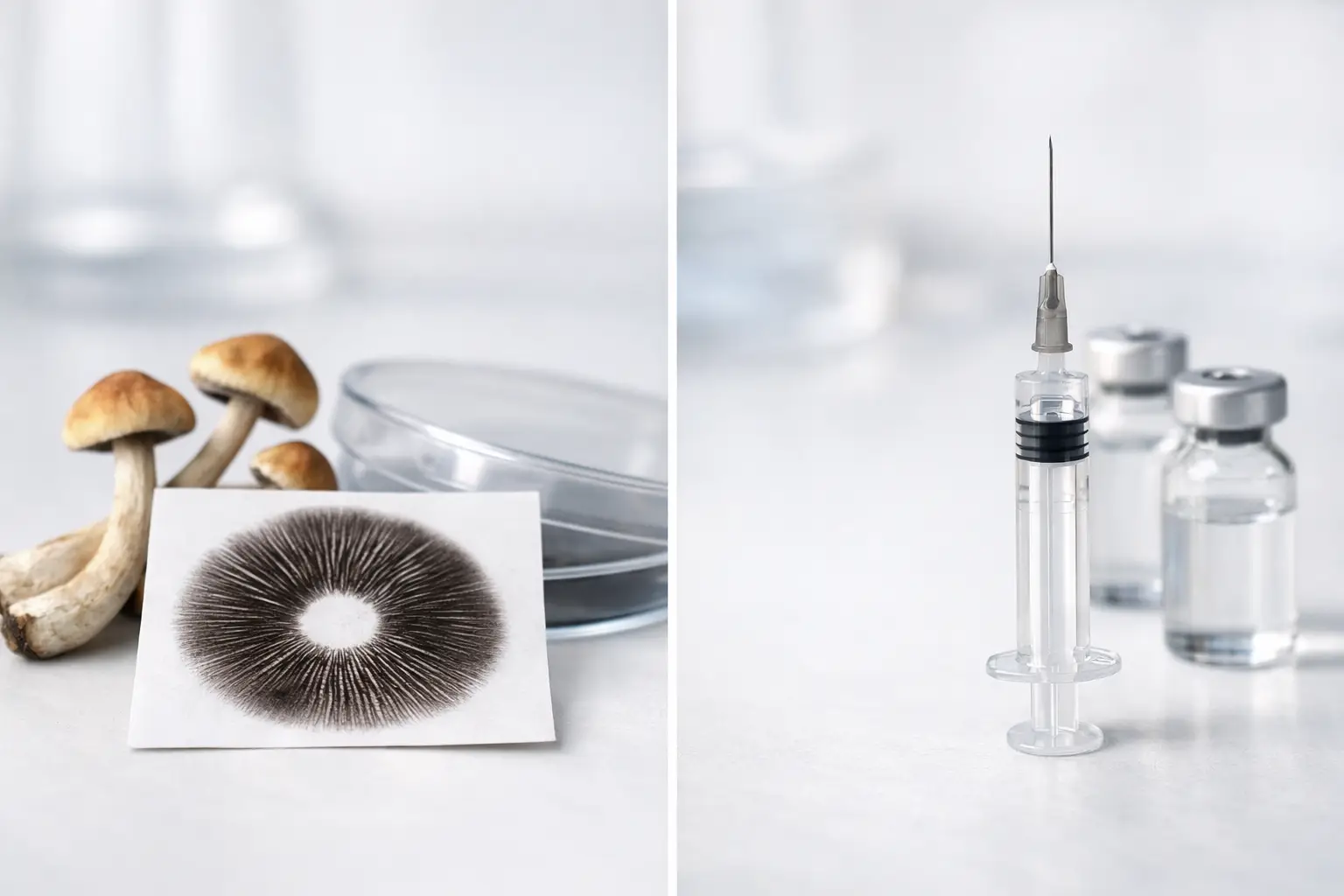
A spore print or syringe can represent the same species, but they deliver a very different experience at the bench, in storage, and in a collection. One puts the spores on display in their original deposit pattern. The other suspends them in a prepared liquid format for convenient handling. Neither is automatically better – the right pick depends on what you want to observe, preserve, compare, or add to your mycology lineup.
For collectors and microscopy-focused buyers, format matters almost as much as species. A clean, well-presented print has archival appeal and gives you a visible record of spore color and density. A syringe is compact, familiar, and built around easy, measured access. Understanding the trade-offs makes shopping by category much simpler.
Spore Print or Syringe: The Core Difference
A spore print is a deposit of spores left on a sterile surface, commonly foil or another nonporous material. It is a physical snapshot of a mushroom’s reproductive material. The deposit may appear dark purple-brown, black, rusty brown, or another shade depending on the species. For microscopy work, the visual character of the print can be part of the appeal before a sample is ever prepared for observation.
A spore syringe contains spores suspended in sterile water. The format is typically sealed in a syringe with a capped needle attachment or dispensing tip, depending on the product. It offers a more contained presentation and a format many hobbyists find easier to store, label, and handle in small quantities.
The most useful distinction is simple: a print is a visible specimen-like format, while a syringe is a liquid delivery format. That difference affects how each product travels, how it is stored, and what kind of buyer tends to prefer it.
Why Collectors Choose Spore Prints
Spore prints have a tangible quality that syringes cannot quite replicate. Each one shows a natural deposit pattern, which can range from a dense, bold impression to a lighter radial spread. For enthusiasts building a diverse archive of species and varieties, that visual identity is part of the value.
Prints are also straightforward to inspect upon arrival. You can see the substrate, the general density of the deposit, and the way the product has been packaged. A properly packaged print is flat, easy to file away, and convenient for buyers who organize their collection by species, date, source, or region.
There is a practical reason to choose prints, too. They generally take up very little space and do not require the rigid shape of a syringe for storage. If your goal is a well-labeled mycology archive rather than a ready-to-handle liquid format, prints make excellent sense.
That said, a print requires more hands-on care if you need to remove a small sample for microscopy. The working surface, tools, and sample handling all matter. Buyers who prefer a contained, portion-friendly format may find a syringe more comfortable.
Best fit for a print
Choose a print when you value visible spore characteristics, flat archival storage, traditional collecting, or the ability to keep an organized physical reference library. They are especially appealing to buyers who enjoy comparing specimens side by side.
Why Buyers Choose Spore Syringes
A syringe is designed around convenience. The spores are already dispersed in liquid, so the format is compact and ready for controlled dispensing when used for lawful microscopy and study purposes. For buyers who do not need the visual presentation of a print, that simplicity is often the deciding factor.
Syringes are also easy to identify at a glance when they are clearly labeled. A neatly organized storage box can hold several varieties without the need to keep individual foil packets flat and separate. This makes them popular with shoppers building variety packs or adding several fan favorites to a single order.
The main trade-off is visibility. Spore density in a syringe is not always obvious to the naked eye. Some spores may settle over time, and the liquid itself does not provide the same immediate visual information as a deposited print. That is normal for the format, but it means a syringe is less satisfying for someone who wants a display-worthy specimen.
Best fit for a syringe
Choose a syringe when you prioritize compact storage, controlled liquid handling, and a familiar ready-to-use format for permitted research or microscopy applications. It is a practical choice for buyers who know they prefer liquid products and want to compare several varieties without overcomplicating their setup.
Storage, Shelf Life, and Handling Considerations
Both formats benefit from careful storage. Keep products clearly labeled, protected from unnecessary heat and direct light, and stored according to the seller’s product guidance. A cool, clean, stable environment is generally preferable to a car, windowsill, garage, or any location with frequent temperature swings.
Prints should stay dry and protected from crushing, bending, or contamination. Keeping each print in its original packaging until you are ready to examine it helps preserve its condition. If you maintain a collection, adding the purchase date and a simple inventory note can make future comparisons much easier.
Syringes should remain capped, sealed, and protected from damage. Avoid forcing or altering components, and do not treat a syringe as a display item. Its strength is contained storage and measured handling, not visual presentation.
Shelf life is not a single fixed number because storage conditions, packaging quality, age, and the product itself all play a role. Instead of relying on a universal timeline, buy from a source that provides clear product information, inspect your order promptly, and store it responsibly from day one.
How to Shop by Your Actual Goal
The fastest way to choose is to start with the experience you want, not the product name. If you want a physical specimen that looks at home in a labeled reference collection, begin with prints. If you want a contained liquid format that is easy to organize with other supplies, start with syringes.
Buyers interested in comparing spore color, deposit structure, or the visual differences among varieties will often get more satisfaction from prints. Buyers who prefer straightforward product handling and compact organization may lean toward syringes. There is no rule saying a serious enthusiast has to choose only one. Many collections include both because each format serves a different purpose.
Species selection should come after format, not before it. Once you know whether you prefer a print or syringe, comparing available varieties becomes more useful. Look for accurate labeling, careful packaging, clear category organization, and product details that help you match the format to your intended lawful use.
For culinary mushroom projects, it may also be worth considering whether an edible culture or another ready-to-inoculate product better matches your goals. Spores, cultures, and prepared products are not interchangeable categories. Shopping with the end use in mind prevents unnecessary guesswork and helps you build a more useful supply shelf.
Quality Signals Worth Looking For
Good shopping decisions come down to more than picking a popular name. Look for clean presentation, clear identification, secure packaging, and a seller that treats product categories seriously. A well-organized catalog makes it easier to compare individual items with bundles, starter options, and collector-friendly selections.
For prints, packaging should protect the sample and make the label easy to read. For syringes, look for intact packaging, secure caps, legible labels, and sensible shipping practices. If you are ordering multiple formats, keep them separated and logged when they arrive so you can maintain clean records.
Myceli Nation is built for buyers who do not want to hunt across scattered suppliers for every format. Whether you are adding a single specimen to your archive or comparing several options in one order, a category-first approach keeps the process direct.
Choose the Format You Will Actually Enjoy Using
A print rewards curiosity, observation, and careful collecting. A syringe rewards convenience, containment, and efficient organization. The better option is the one that fits how you engage with mycology, not the one that happens to be most common in someone else’s supply box.
Start with one format that matches your immediate interest, label it well, and give yourself room to compare the other format later. A thoughtful collection grows best when every item has a clear reason to be there.