
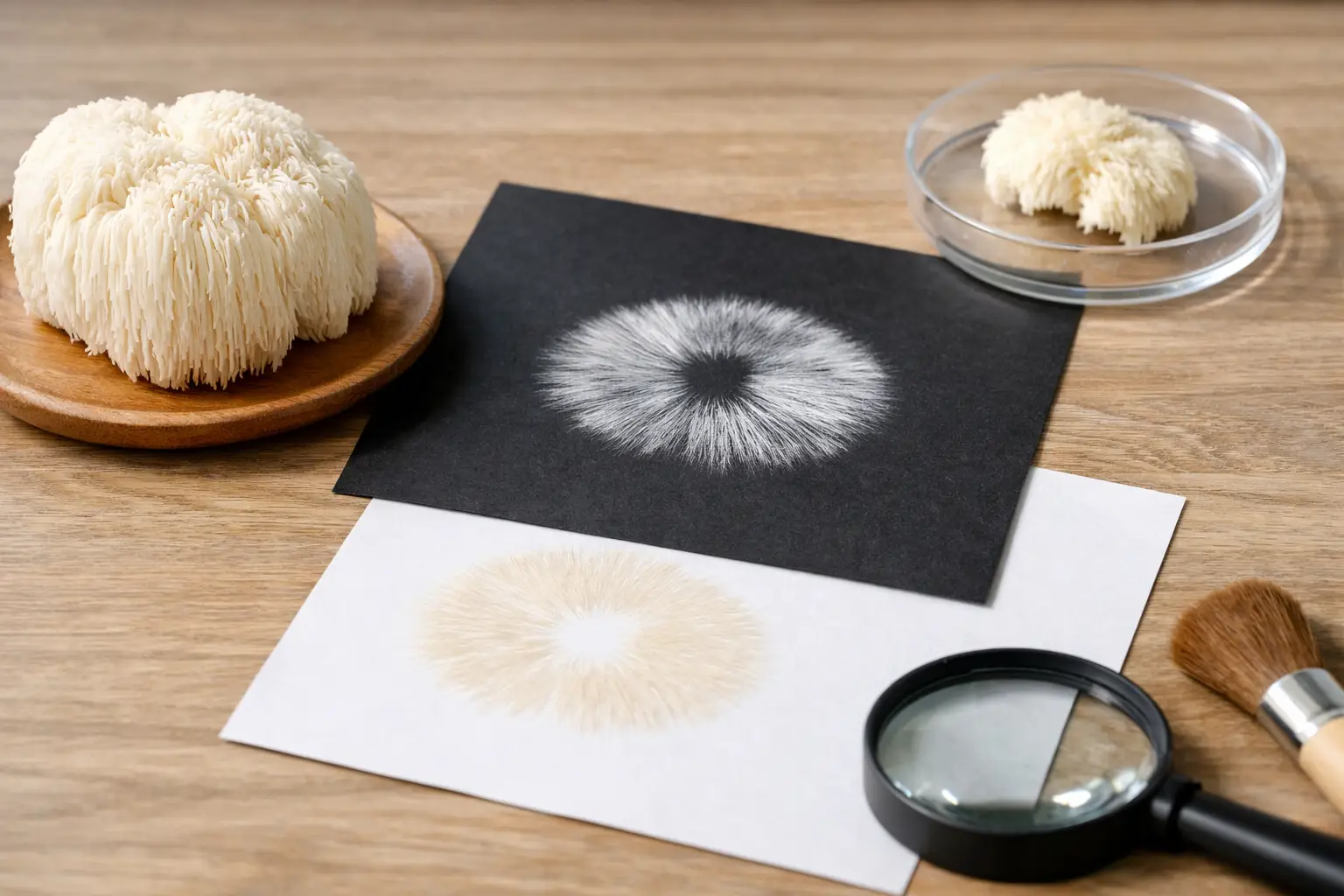
If you’re figuring out how to spore print lion’s mane, the first thing to know is that it does not behave like a gilled mushroom. That single detail is where most failed attempts start. Lion’s mane releases spores from tiny teeth, not caps and gills, so timing, orientation, and patience matter a lot more than people expect.
For growers used to oyster or button mushrooms, lion’s mane can feel a little awkward at spore-print time. The fruiting body is shaggy, dense, and often harvested before it gets truly mature because texture and flavor are best on the younger side. If your goal is getting a visible print, you usually need to let one fruit go past peak kitchen quality. That trade-off is normal.
How to spore print lion’s mane successfully
A lion’s mane spore print starts with a mature fruiting body that is still clean and intact. You want a specimen with long, well-developed teeth and no signs of rot, heavy bruising, or bacterial slime. A very young fruit usually will not drop enough spores to give you much to work with, while an overripe one can turn messy fast.
Unlike broad-capped mushrooms, lion’s mane does not lend itself to the classic cap-on-foil method. The spores fall from the hanging spines, so you need to position the fruit so those teeth are pointed down over a clean surface. In practical terms, that means placing a trimmed chunk or a small whole fruit over foil, black paper, glass, or another smooth collection surface where spores can settle.
White spores on a white plate are a frustrating choice. Since lion’s mane spores are pale, a dark background tends to make the print easier to spot. Black paper can work, but smooth foil or glass is often easier if you plan to scrape and transfer material later.
What you need before you start
Keep the setup simple. You need a mature lion’s mane fruit, a sterile blade or scissors, clean aluminum foil or a sterile glass dish, and a cup, bowl, or container to cover the sample. Some growers lightly mist the surrounding area beforehand to settle dust, but you do not want moisture collecting directly on the print surface.
Clean handling matters here because lion’s mane prints are often faint. Any lint, dust, or fibers can overwhelm what you are trying to collect. Wash your hands, sanitize your tools, and work in a still-air area away from vents or fans.
Choosing the right fruiting stage
This is the part that makes or breaks the process. Lion’s mane should be mature enough that the teeth are elongated and the fruit has begun shifting from tight pom-pom growth into a more open, cascading form. If the spines are still short nubs, wait. If the fruit has started yellowing heavily or softening, you may still get spores, but contamination risk rises and quality drops.
A lot of growers harvest lion’s mane before prime spore release because that is when it looks best and cooks best. So if you are serious about learning how to spore print lion’s mane, plan ahead and designate one fruit for the job. Letting one specimen mature fully is usually more productive than trying to print leftovers from a harvest that was taken early.
Whole fruit or trimmed section?
It depends on the shape. A small whole fruit can be suspended or set over the print surface if the teeth naturally hang downward. A large cluster is often easier to trim into a manageable section. The main goal is simple: exposed fertile surface facing down, close enough to the collection surface for spores to land, but not pressed against it.
If the fruit sits directly on the foil or glass, air circulation around the teeth is reduced and moisture can build up. Leave a little clearance if you can. Even a small support ring made from clean foil can help elevate the sample.
Step-by-step setup for a lion’s mane spore print
Start by preparing your collection surface. Lay down foil shiny side up, or place a clean glass dish in your work area. Then cut a mature section of lion’s mane with minimal handling of the teeth.
Place the fruit so the spines point straight down toward the surface. Cover it with a clean bowl, deli container, or large cup to reduce airflow and contamination. The cover should protect the setup without sealing in heavy condensation.
Leave it undisturbed for 8 to 24 hours. Lion’s mane can be less dramatic than some other species, so don’t expect a bold, dark print. In many cases, what you get is a subtle white dusting rather than a sharply defined pattern.
When time is up, lift the cover carefully and remove the fruit gently. Tilt the surface under good light. A flashlight from the side can help reveal a thin spore layer that looks invisible head-on. If you see a faint powdery deposit, that is often your print.
Why some prints seem to fail
Most failed lion’s mane prints come down to three things: the fruit was too young, the spores were too pale to notice, or excess moisture interfered with collection. There is also the possibility that the specimen simply was not in an active spore-drop window during the time you left it set up.
This is one of those cases where patience beats overhandling. If the first attempt gives you little or nothing, try again with a more mature fruit or extend the collection window. Just keep an eye on humidity inside the cover. Too dry and spore drop may be weak. Too damp and the surface gets messy.
Handling and storing the print
Once you have a visible lion’s mane spore print, let the surface air dry briefly in a clean, still area if there is any trace of moisture. Then fold the foil carefully or transfer the print to a clean storage setup. If you used glass, you can scrape the spores with a sterile blade into a sterile container.
Label everything right away. Include species name and date at minimum. It sounds basic, but once you start collecting more than one sample, unlabeled material becomes guesswork fast.
Storage should be cool, dry, and dark. The cleaner the print when collected, the better it tends to hold up. If your print is mixed with condensation spots, substrate debris, or tissue fragments, it is less reliable as a clean reference sample.
Print quality versus culture quality
There is a practical point worth saying plainly: with lion’s mane, cloning tissue is often more straightforward than chasing a heavy spore print. Spores can absolutely be collected, but many growers prefer tissue work when they want to preserve a fruit they already like. Spore printing is still useful for study, documentation, and collection purposes, but it is not always the most efficient route if your only goal is propagation.
That does not mean printing lion’s mane is a waste of time. It just means expectations should be realistic. Some species throw obvious, satisfying prints. Lion’s mane tends to be more subtle and more dependent on perfect timing.
Common mistakes when learning how to spore print lion’s mane
One common mistake is harvesting too early because the fruit looks ready from a culinary standpoint. Another is using a white plate and assuming no spores dropped when the print is simply hard to see. The third is trapping too much humidity under the cover, which can leave you with moisture instead of a clean powdery deposit.
Rough handling is another issue. The teeth are delicate, and squeezing or flattening them can reduce your chances of getting a good print. Try to move the fruit as little as possible once it is cut and positioned.
It also helps to avoid high-traffic workspaces. A faint white print can be spoiled by a single stray hair, paper fiber, or dust layer. If you are already set up with basic sterile workflow for cultures and supplies, use that same mindset here.
What a good lion’s mane print should look like
Do not expect a classic umbrella-shaped print pattern. Since the fertile surface is made up of hanging spines, the deposit may look diffuse, uneven, or softly dusted rather than sharply outlined. That is normal.
Under angled light, a successful print often appears as a pale white powder on the collection surface. On dark material, it may show up as a soft chalky patch. On foil, it can be more reflective and easier to spot when you tilt it.
If you are building out a personal reference collection or just refining your technique, this is where repetition helps. One clean, mature fruit can teach you more than several rushed attempts.
For growers and collectors in The Mycelium Network, that is really the mindset to bring to lion’s mane – less hurry, more observation. Give the fruit time, keep the setup clean, and let the species show you how it wants to print.