
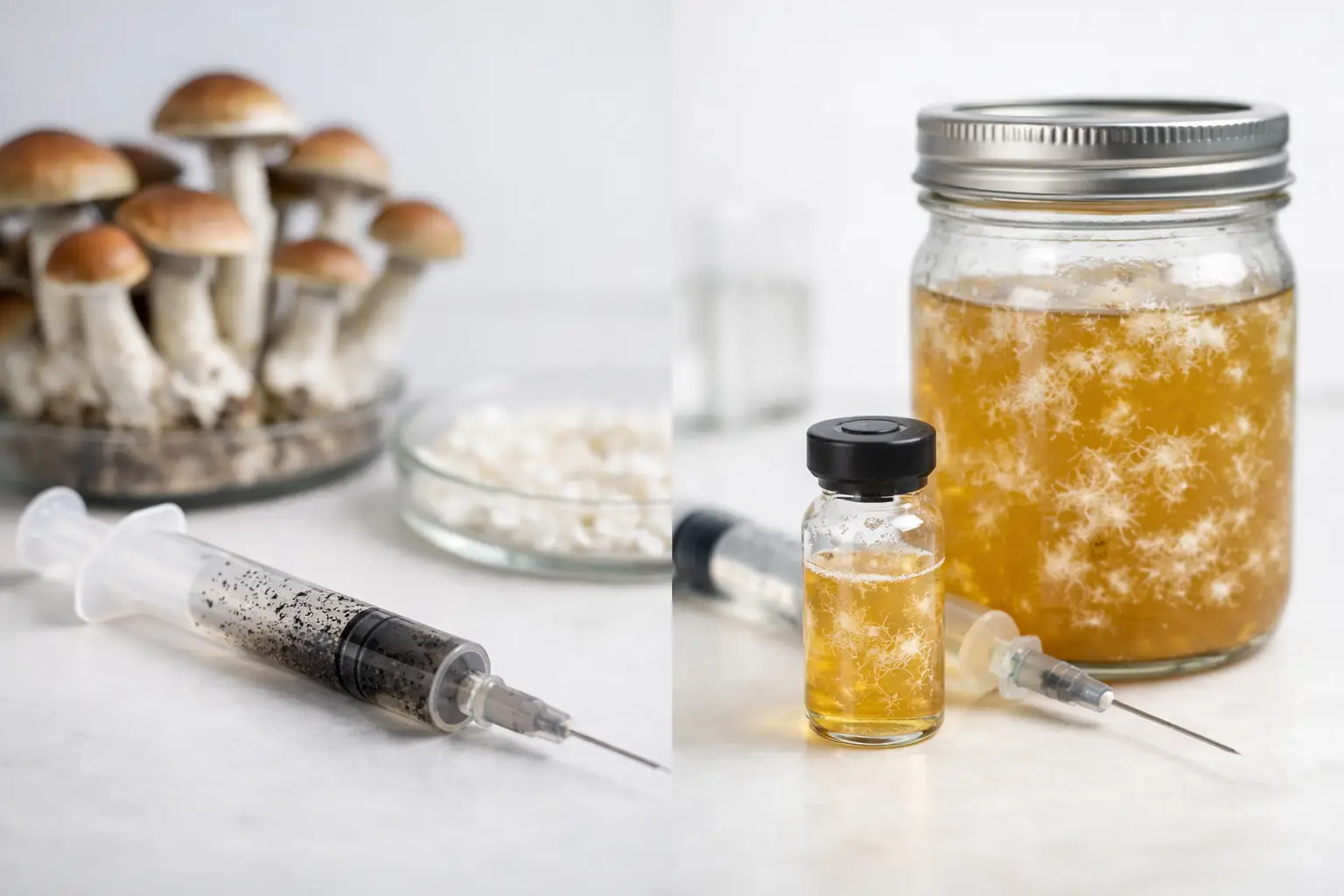
If you have ever paused on a product page deciding between a spore syringe and a culture syringe, you are already asking the right question. Mushroom spore syringe vs liquid culture is not just a product comparison – it shapes colonization speed, consistency, storage expectations, and the kind of cultivation workflow that makes the most sense for your setup.
For buyers who already know their way around strain names and supply categories, the real difference comes down to what you want from the material in front of you. Are you prioritizing genetics in spore form, broader starting potential, or a faster and more uniform jump into active mycelial growth? Those are two very different starting points, even when the syringes may look similar in a storefront.
Mushroom spore syringe vs liquid culture at a glance
A mushroom spore syringe contains spores suspended in sterile solution. A liquid culture contains living mycelium already established in nutrient liquid. That sounds simple, but the downstream effect is substantial.
Spores are the starting reproductive cells. They have to germinate and pair before forming active mycelium. Liquid culture skips that early phase because the mycelium is already present and growing. In practice, that usually means liquid culture can move faster in suitable applications, while spore syringes offer a more foundational format that many collectors and microscopy-focused buyers already know well.
The key point is that one is not automatically better than the other in every scenario. A lot depends on whether you want speed, consistency, storage flexibility, microscopy appeal, or a specific way of sourcing genetics.
What a spore syringe is best at
Spore syringes remain a staple for good reason. They are familiar, straightforward to store correctly, and widely recognized across the mycology space. For buyers who are browsing a broad menu of strains and want access to classic options in a standard format, spore syringes are often the easiest place to start.
One advantage is accessibility. Many hobbyists build their early sourcing habits around spores because the format is common, easy to compare across varieties, and simple to add to a broader order with prints, supplies, or bundled packs. If you like shopping by category and keeping your options open, spores fit neatly into that process.
There is also a variability factor. Because spores represent the beginning of a genetic process, results can be less uniform than a well-established culture. For some buyers, that is a drawback. For others, it is part of the appeal. It depends on whether you want a more standardized starting point or are comfortable with a format that begins earlier in the life cycle.
Shelf life is another reason people reach for spore syringes. When stored properly, they can be a practical choice for buyers who are planning ahead, building out a collection, or placing a larger order and using items over time rather than all at once.
Where liquid culture stands out
Liquid culture is often the choice for growers who want a more active starting point. Instead of waiting for spores to germinate, you are working with living mycelium that is already established in solution. That usually makes liquid culture especially attractive to cultivators who value speed and cleaner workflow timing.
Consistency is the other major reason people prefer this format. Since the mycelium is already growing, a good liquid culture can offer a more predictable jump-off point than spores. If your main goal is efficient colonization and repeatable results within your process, liquid culture often makes more sense.
That does not mean it is automatically the best fit for every cart. Liquid culture can be more sensitive to handling, age, and storage conditions because it is a live culture, not just dormant reproductive material suspended in sterile water. Buyers who want to stock up far in advance may weigh that differently than someone ordering for immediate use.
For many edible cultivation customers, liquid culture feels like the more purpose-driven format. It lines up well with practical production goals and tends to appeal to shoppers who already know they want active mycelium rather than spores.
Speed vs flexibility
Most comparisons eventually land here. If you strip away the terminology, mushroom spore syringe vs liquid culture is often a decision between flexibility and speed.
Spore syringes offer flexibility in the sense that they are a widely available, familiar format with good variety across many strain catalogs. They are easy to browse, easy to recognize, and often easy to store for future plans. That makes them a strong retail-friendly option for buyers who want selection and convenience.
Liquid culture usually wins on speed because it begins with established mycelium. For growers trying to reduce lag time in the early stages, that matters. Even small differences at the beginning can shape the overall rhythm of a grow cycle.
Still, speed is not the only thing worth paying for. Some buyers simply prefer the broader menu of spore options available in many shops. Others like having both formats available depending on the species, the project, or how soon they plan to use the syringe.
Consistency and genetic starting point
This is where the trade-off becomes more technical without getting complicated. A spore syringe starts from spores, which means germination and pairing still need to happen. That introduces more variation at the beginning. A liquid culture starts from mycelium that is already active, which generally reduces that variability.
If you are after a more uniform starting line, liquid culture usually has the edge. If you are sourcing based on strain availability, catalog breadth, or your own preference for spore-based material, a spore syringe may still be the better buy.
For many experienced shoppers, this is less about right and wrong and more about product intent. Spore syringes and liquid cultures belong in different lanes, even when they share similar packaging.
Storage and handling matter more than people think
A lot of buying decisions are made on product format alone, but storage habits should be part of the comparison. Spore syringes are often viewed as more forgiving for longer-term holding when stored correctly. Liquid culture, because it contains live mycelium in nutrient solution, usually benefits from tighter timing and more attentive storage practices.
That matters for ecommerce buyers who tend to place larger mixed orders. If your plan is to shop once, build inventory, and use products gradually, spore syringes may fit that pattern better. If you are ordering with a near-term project in mind and want a more active material ready to go, liquid culture may be the smarter pick.
This is one of those details that separates a quick purchase from a good purchase. The best product on paper is not always the best product for your schedule.
Which format makes sense for different buyers?
Newer buyers often gravitate toward spore syringes because they are common, easy to identify, and available across a wide range of fan-favorite varieties. They also fit well into bundle-style shopping, where someone may want to compare multiple genetics in one order.
More cultivation-focused buyers often lean toward liquid culture when the goal is active growth and a more efficient start. That is especially true for edible culture shoppers who want a format aligned with practical cultivation use rather than just strain exploration.
Collectors and microscopy-focused buyers may still prefer spores because the format matches their purpose more naturally. On the retail side, this is why a well-built catalog benefits from carrying both. They serve overlapping audiences, but not identical ones.
If you are somewhere in the middle, the answer may simply be to match the format to the project. Not every species, timeline, or buying habit calls for the same thing.
A better way to choose before you buy
Instead of asking which is better overall, ask a few narrower questions. Do you want active mycelium or spores? Are you ordering for immediate use or later use? Are you prioritizing catalog variety or colonization speed? Are you shopping with microscopy, collection, edible cultivation, or general sourcing in mind?
Those questions usually sort the answer quickly.
If your priority is broad selection, familiar format, and a syringe you may want to store properly for a bit, a spore syringe is often the cleaner fit. If your priority is faster movement from the start and a more consistent active culture format, liquid culture usually makes more sense.
That is the real value in understanding mushroom spore syringe vs liquid culture. You stop shopping by label alone and start buying for the result you actually want.
At Myceli Nation, that kind of clarity is what makes a product catalog useful instead of overwhelming. The right format is the one that fits your timeline, your goals, and how you move through the mycology supply world.