
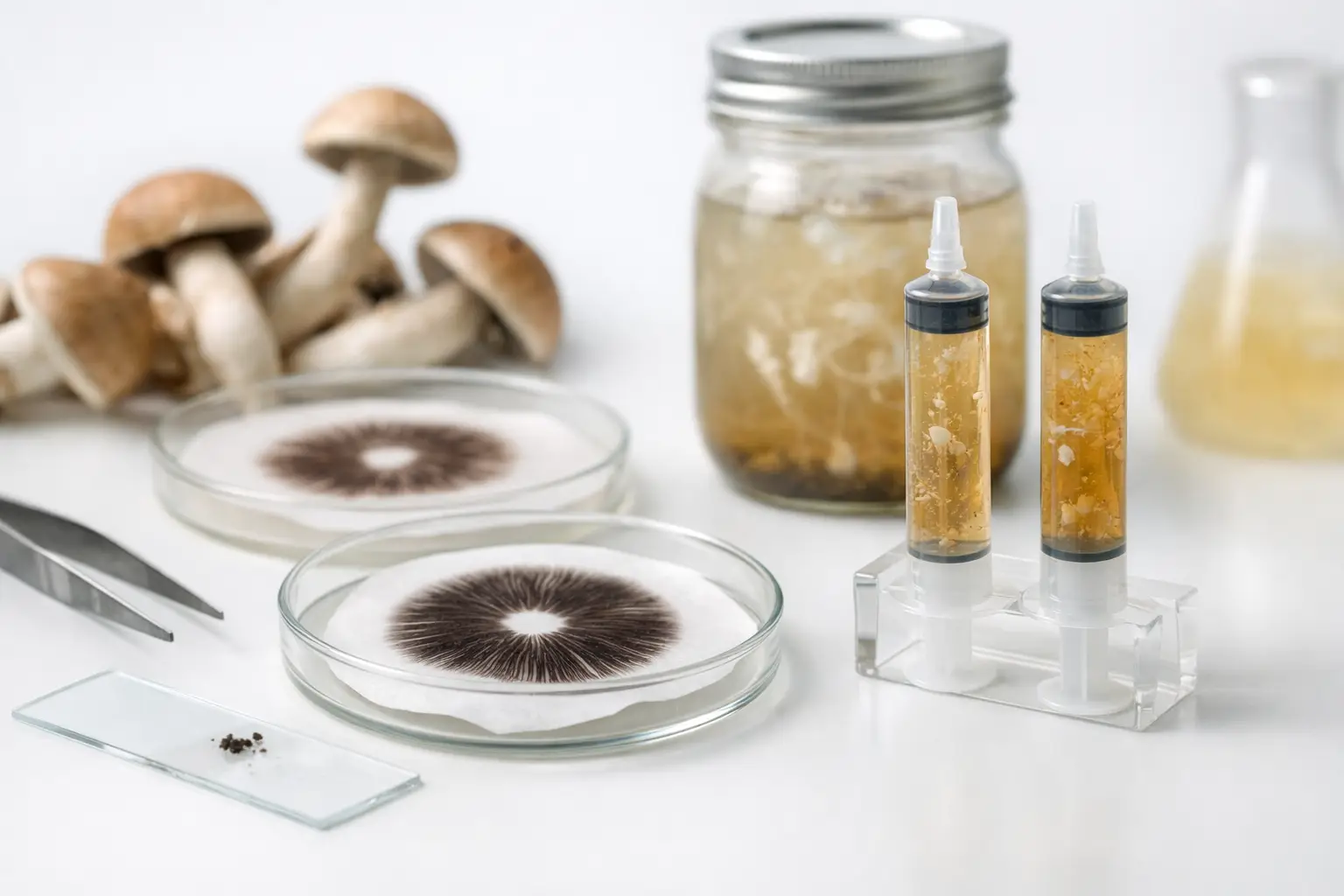
A spore print can sit neatly in a collection, travel easily, and preserve the starting point of a mushroom variety in a remarkably simple format. Liquid culture, by contrast, is built for momentum: living mycelium suspended in a nutrient solution and ready for the next stage of an edible cultivation workflow. That difference is the heart of the spore print vs liquid culture decision.
Neither format is automatically better. The right choice depends on whether you value long-term storage, microscopy, genetic exploration, quick project turnaround, or a dependable repeatable workflow. Knowing what each format does well makes it much easier to shop with purpose instead of grabbing the option that simply sounds more advanced.
What a Spore Print Brings to the Table
A spore print is a visible deposit of spores collected from a mature mushroom cap. It is one of the most traditional formats in mycology, and it remains popular because it is compact, versatile, and useful for study, collecting, and preservation.
For hobbyists interested in microscopy, prints offer a direct starting point for observing spores and comparing characteristics between varieties. They are also appealing to collectors because each print represents a distinct mushroom specimen and can be labeled, organized, and stored with minimal space.
The larger advantage is potential diversity. Spores are reproductive cells, so a print does not represent one fixed mycelial culture. When spores are studied or used in appropriate edible projects, the resulting growth can express variation. That makes prints especially interesting for enthusiasts who enjoy the discovery side of mycology rather than chasing identical outcomes every time.
A print is also a practical format for keeping a personal library. Properly handled and stored in a cool, dry, clean location, it takes up very little room. For someone building a broad collection of mushroom varieties, prints are often the easiest format to catalog over time.
The Trade-Offs With Prints
Flexibility comes with more variables. A print is not a ready-to-use living culture. It requires careful clean handling for microscopy work or for any lawful edible cultivation process, and it may require more time before a project reaches the same point as one started from an established liquid culture.
Because spores can produce varied genetics, results are less uniform. That is a feature for exploration, but it can be a drawback for growers who want consistency in a familiar edible variety. Prints also demand more attention to storage conditions and handling hygiene, since the material is exposed when opened.
What Makes Liquid Culture Different
Liquid culture contains actively growing mycelium in a sterile nutrient broth. In edible mushroom cultivation, it is valued for reducing the time needed to establish growth compared with starting from spores. Rather than beginning with reproductive material, the grower begins with a living mycelial network.
That makes liquid culture attractive for projects where speed and repeatability matter. A well-maintained culture can offer more predictable traits than a spore-based start because it is based on an existing mycelial line. For growers who have already found a favorite edible culture, that consistency can simplify planning and help them keep their process organized.
Liquid culture is also a convenient format for those who do not want to build every project from the earliest stage. It gives newer edible growers a more accessible entry point while still rewarding careful sterile technique and observation. The format is straightforward, but it is not a shortcut around good habits.
The Trade-Offs With Liquid Culture
Liquid culture is perishable compared with a dry print. Its quality depends on how it was prepared, stored, and handled throughout its life. A culture that looks active is not automatically verified as clean, which is why experienced cultivators treat quality control as part of the process rather than an optional extra.
It also offers less genetic variety. When you purchase or preserve a single culture, you are working from one established mycelial line. That is ideal when consistency is the goal, but it does not provide the same exploratory potential as spores from a print.
Storage is another consideration. Liquid cultures need more care, have a shorter practical shelf life, and are more sensitive to temperature swings. If you are building a long-term collection rather than planning a near-term edible project, prints may be the lower-maintenance option.
Spore Print vs Liquid Culture: The Real Comparison
The simplest way to compare these formats is to think about what you want your starting material to do. A spore print is a versatile source material with potential for microscopy, collecting, preservation, and genetic variation. Liquid culture is an active mycelial format intended for efficiency and more repeatable edible cultivation projects.
Speed is the clearest dividing line. Liquid culture generally moves a project forward sooner because mycelium is already established. A print begins at an earlier biological stage, so it calls for more patience and more room for natural variation.
Consistency is the next major factor. Liquid culture is usually the better fit when you want to work with known characteristics from a selected line. A print is a better fit when variability is part of the appeal, whether that means microscopy comparisons, building a collection, or exploring the diversity inherent in spores.
Then there is storage. Dry prints are easier to archive and take up almost no space. Liquid culture is more time-sensitive and requires closer attention. Neither is difficult in the right context, but they serve different collection habits.
Which Format Fits Your Goals?
Choose a spore print if your interest centers on microscopy, collecting, preserving a wide range of varieties, or learning more about the reproductive side of mushroom biology. Prints are also a strong option for enthusiasts who enjoy a slower, more hands-on path and understand that variation is part of the experience.
Choose liquid culture if you are focused on lawful edible mushroom projects and want a living culture that can help create a more efficient, repeatable workflow. It is especially useful when you already know the edible variety you want to work with and prefer fewer genetic unknowns.
Many serious enthusiasts keep both. Prints build the archive and support exploration. Liquid cultures support active projects. Together, they make a collection feel less like a shelf of products and more like a working mycology library.
Buying and Handling With a Clear Plan
Before selecting either format, consider how soon you plan to use it, how you will store it, and whether your interest is educational, collectible, or tied to edible cultivation. Buying a liquid culture for a project months away may not make as much sense as choosing a print for storage. On the other hand, selecting a print when you want to begin an edible project promptly can add steps you did not intend to take.
Pay attention to labeling, variety information, packaging quality, and the seller’s handling standards. For liquid cultures, clear identification and careful shipping matter because you are receiving living material. For prints, secure packaging and proper labeling help keep a collection organized from the start.
At Myceli Nation, the goal is to make those choices easier by giving mushroom enthusiasts access to a broad range of formats, from collectible prints to edible cultures and cultivation essentials. The best purchase is not necessarily the most popular one. It is the one that matches your next move.
A well-chosen format keeps the hobby enjoyable: pick prints when curiosity and preservation lead the way, and choose liquid culture when your edible workflow calls for an established living start. Always handle mushroom materials responsibly and follow the laws that apply where you live.